

Introduction to AI Visibility
Imagine entering a room full of people, yet no one notices you. This is a bit like how companies feel when they are not visible in the digital space. The visibility of Artificial Intelligence (AI) is a key factor for being noticed in today’s digital world. But what does AI visibility actually mean?
Definition of AI Visibility
AI visibility refers to the ability of an AI system to be recognized and used in digital environments. It concerns how well an AI solution appears in search results and how effectively it captures user attention. A good example is ChatGPT, which achieves high visibility thanks to its ability to generate natural and context aware responses. AI visibility is influenced by various factors including content quality, the use of keywords, and the technical optimization of the platform.
Why Visibility Matters for Companies
Why is this important? Because visibility equals success. Companies that make their AI solutions visible can expand their reach, attract new customers, and strengthen their market position. In today’s digital landscape, where competitors are only a click away, visibility can determine whether a business succeeds or fails. High visibility in AI search systems means a company is better positioned to benefit from digital transformation.
Current Trends in AI Visibility
Trends in AI visibility are evolving quickly. One major trend is Generative Engine Optimization (GEO), which aims to optimize content so that it appears in the generated responses of AI systems such as ChatGPT. GEO goes beyond traditional Search Engine Optimization (SEO) and focuses on making content machine readable and relevant. Another trend is the use of semantic SEO, which promotes related terms and thematic clusters to increase the relevance and visibility of content.
In an era shaped by AI driven search, understanding and applying the rules of visibility is essential. Companies that do this well can gain a competitive advantage and strengthen their position in the digital world.

Technological Foundations of ChatGPT
Imagine talking to a friend who not only has an answer to every question but expresses it in a tone and style that feels familiar. That is exactly what ChatGPT enables through its technological foundations. Let’s dive into the fascinating technology that powers ChatGPT.
Transformer NLP: The Foundation of Language Processing At the core of ChatGPT lies a Transformer based architecture for Natural Language Processing (NLP). This technology revolutionizes how machines understand and generate language. Unlike earlier models that looked at words in isolation, the Transformer analyzes relationships between words across an entire sentence. Think of a puzzle where each piece is interpreted not only on its own but in relation to the others. This allows ChatGPT to produce contextually accurate and human sounding responses. For example, if you ask ChatGPT, “What are the best SEO strategies for 2025?”, it understands not just the terms “SEO” and “strategies” but the full context and provides a comprehensive answer that reflects current trends and best practices.
Next Token Prediction: The Art of Anticipation Another key component of ChatGPT is next token prediction. This allows the model to infer the next word based on the flow of text so far. Imagine reading a gripping novel and trying to guess what comes next. ChatGPT does the same thing at machine speed and precision. This capability is essential for generating smooth and coherent text.
Practical Applications of These Technologies The combination of Transformer NLP and next token prediction makes ChatGPT a powerful tool in many fields. It supports content creation, customer communication, and decision making. Businesses use ChatGPT to optimize their SEO strategies by generating content that appeals both to humans and search engines. In short, the technological foundations of ChatGPT are not only impressive but also practical and versatile. They enable natural and context aware interactions that change how we communicate with machines.
Strategies to Improve AI Visibility Imagine having a great website with fantastic content yet no one sees it. Frustrating, right? This is where strategies for improving AI visibility come into play. In 2025, optimizing for AI search systems is essential to stay visible in the digital space. But how does it work?
Applying Semantic SEO Semantic SEO is more than sprinkling keywords. It focuses on understanding the meaning behind search queries and shaping content accordingly. Tools like SEMrush and Ahrefs help identify thematic clusters and related terms. If you write an article about sustainable energy, for example, you would integrate related terms like renewable resources or green technologies. This makes your site more relevant for AI systems and increases its chances of appearing in generated responses.
Using Structured Data Structured data is the backbone of a machine readable website. It helps AI systems better understand and interpret content. Use Schema.org markups to clearly identify authors, articles, or FAQs. If you share a recipe, for instance, you can use the Recipe markup to structure ingredients, cooking time, and nutritional values, making it easier for AI systems to highlight your content.
Integrating Question Answer Formats AI systems value clarity and precision. Question answer formats, such as FAQs or how it works articles, are ideal for being recognized as a source. These formats provide clear responses to specific questions, increasing the likelihood of appearing in AI generated answers. If a user asks, “How does solar energy work?”, a precise and well structured section on your website could be selected by an AI system.
Freshness and Clarity of Content Regular updates signal trustworthiness and make your content more attractive for AI search systems. Keep information fresh and relevant. Clear writing also matters. Use short paragraphs, concise headings, and bullet points to improve readability and make your content AI friendly. These strategies are not just theoretical. By applying semantic SEO, using structured data, and integrating question answer formats, you can significantly improve the visibility of your AI driven content.
Generative Engine Optimization (GEO)
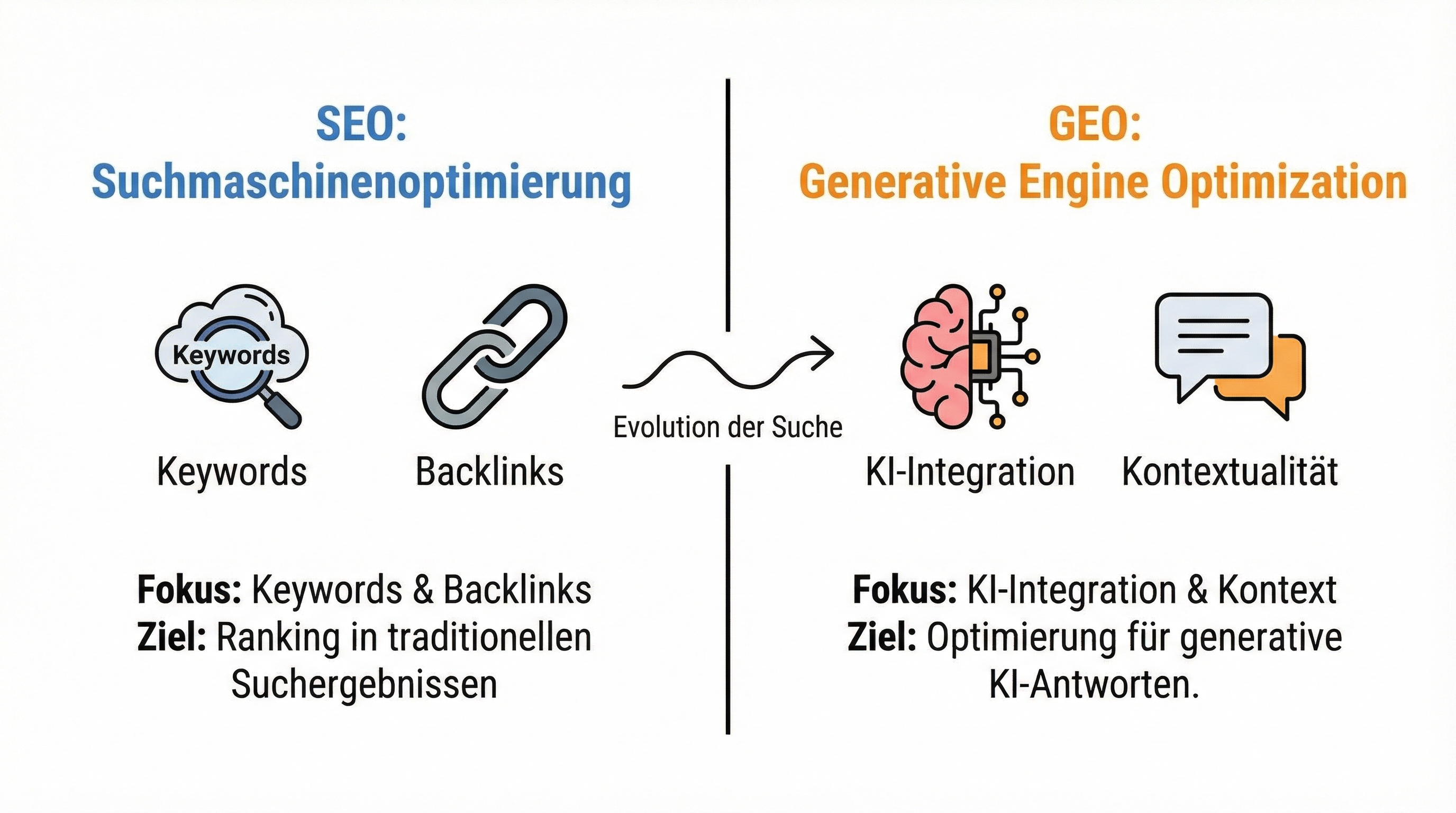
Generative Engine Optimization is the new playing field in digital visibility. While traditional SEO focuses on ranking websites in search engines, GEO aims to make content appear in generated responses from AI systems such as ChatGPT, Google’s SGE, or Perplexity. GEO is more than an extension of SEO. It is a necessary adaptation to a rapidly changing digital landscape.
Differences Between SEO and GEO
SEO and GEO share the goal of maximizing online visibility, though their methods differ. SEO optimizes websites for high ranking in search results using keywords, backlinks, and technical performance. GEO focuses on making content understandable and contextually relevant for AI systems so that it can appear directly in generated answers.
The Importance of GEO for Visibility
GEO is crucial in a world where users expect direct answers. Companies need to shape content so that AI systems can recognize and use it. GEO increases reach by prioritizing content that is both informative and context aware. This requires deep insight into user needs and precise content alignment.
Adapting Content Strategies
To use GEO effectively, companies must create content that is informative, clearly structured, and easy to interpret. Structured data and semantic SEO support machine understanding. Regular updates ensure relevance.
Question answer formats are especially important because they help AI systems process and reuse information. Companies that adopt GEO early gain an advantage in the AI driven search era.
Overall, GEO requires a new mindset. Content must be optimized not only for humans but also for machines. Companies that accept this challenge will strengthen their visibility in an increasingly AI dominated environment.
Challenges and Solutions for Companies
Integrating AI into business processes is one of today’s major challenges. The MIT study State of AI in Business 2025 shows that 95 percent of generative AI pilot projects fail to deliver measurable ROI. This raises tough questions. Why do so many companies struggle, and how can they improve AI visibility?
Common Implementation Challenges
One key difficulty is the lack of integration between AI and existing processes. Many pilot projects remain isolated and never reach operational maturity. Organizations often fail to learn from data and experience or to incorporate these insights into strategy.
Another issue is organizational design. Traditional structures can limit the flexibility needed for successful AI adoption. Adjusting to new technology often requires restructuring, which many companies hesitate to undertake.
Success Factors for High AI Visibility
Companies should define clear goals and benefits for AI projects. Initiatives must be both technologically innovative and aligned with business value.
Continuous workforce training is essential. The job market increasingly demands AI skills, and companies must train employees accordingly.
Solutions to Common Problems
Companies can begin with small, manageable AI initiatives instead of large risky projects. Gradual integration builds confidence and reduces risk.
Promoting an open culture that supports innovation is also important. Training and workshops can improve understanding and acceptance of AI.
Partnerships with specialized providers help reduce costs and offer access to advanced technology.
Overall, successful AI implementation requires technological expertise, strategic planning, and cultural openness. Companies that embrace these factors can significantly improve their AI visibility and maintain long term competitiveness.

Outlook: AI Visibility in 2026 and Beyond
AI visibility will continue to grow in importance during the coming years. By 2026 and beyond, AI will be more deeply and broadly integrated into digital interactions.
Expected Trends
A key trend is the deeper integration of AI in everyday applications. Systems such as ChatGPT will become more common in communication platforms and business tools to improve efficiency and personalization. Advances in NLP will further support this development.
Technological Progress
Generative Engine Optimization will play a central role. It focuses on optimizing content so AI systems prioritize it in generated answers. Semantic SEO and structured data will be essential to maximize visibility in AI driven search. Early adopters will gain a competitive edge.
Long Term Impact on Businesses
AI visibility will reshape business operations. Companies that adopt AI successfully can boost efficiency and develop new business models. But they must balance innovation with ethical considerations. The 2025 MIT study shows that many companies still struggle to realize the full value of AI. Adjusting structures and training employees will be crucial.
The future of AI visibility depends on combining technological advancement with human insight. Companies that manage both will be well equipped for a rapidly evolving digital landscape.
Case Studies: Successful AI Visibility Implementation
Imagine running a midsized company and wanting to improve your online presence. You have heard about the power of AI, but how exactly can it help you become more visible? Here are a few inspiring examples.
Example 1: E Commerce Company
A leading e commerce company used AI to optimize product recommendations. By using ChatGPT to analyze customer data, they were able to offer personalized suggestions in real time. This increased their conversion rate by 20 percent. The natural tone of ChatGPT strengthened customer engagement and improved brand visibility.
Example 2: Healthcare Sector
A hospital improved visibility by implementing semantic SEO and structured data. FAQs and how it works articles helped the site gain relevance in AI search systems. This led to more patient inquiries and stronger patient retention.
Example 3: Education Sector
A university used GEO to optimize content so that it appeared in responses generated by AI tools such as ChatGPT. This improved enrollment rates because prospective students could instantly find relevant information.
Lessons Learned
These examples show that successful AI visibility requires both technical expertise and strategic planning. Understanding user needs and tailoring AI tools accordingly allows companies to increase visibility and secure long term success.