

Introduction to Keyword Gap Analysis
Imagine you run a small but excellent bakery in your town. Your croissants are a big hit, yet somehow the baker around the corner attracts more customers. Why? It might be due to the keywords they are using online. This is where keyword gap analysis comes into play.
Keyword gap analysis is a strategic tool in the field of search engine optimization (SEO) that helps you identify the gaps between the keywords your website ranks for and those used by your competitors. Simply put, it is about finding out which keywords your competitors are leveraging that you are still missing. This analysis is crucial for uncovering untapped opportunities and optimizing your content strategy.

Why Is Keyword Gap Analysis Important?
In today’s digital landscape, where 96.55 percent of all content receives no organic traffic from Google, it is crucial to stand out from the crowd. An effective keyword gap analysis can help you do exactly that by showing where you are falling behind your competitors. It enables you to focus specifically on keywords with lower competition and thereby increase your visibility in search engines.
First steps and goals of the analysis
The first step in a keyword gap analysis is selecting a suitable keyword research tool such as Semrush, Ahrefs, or LowFruits. These tools help you extract your competitors’ keywords and compare them with your own. The next step is to identify the keywords for which your website does not rank, but your competitors do. These “gaps” represent your opportunities.
The goal of keyword gap analysis is to develop a data-driven content strategy that pushes your website forward in search engine rankings. By targeting keywords with low keyword difficulty, typically in the range of 0 to 50, you can achieve faster results, especially if your website is still relatively new.
Keyword gap analysis is therefore not just a technical tool, but a strategic approach to strengthening your online presence. It helps you ask the right questions and find the right answers in order to take your SEO efforts to the next level.
Step-by-Step Guide to Keyword Gap Analysis
A keyword gap analysis is an exciting process that helps you identify and close the gaps in your SEO strategy. Think of it like a treasure map showing where your competitors are succeeding and where you still have untapped potential. Sounds good? Let’s walk through the steps together.
1) Choose the right tool
The first step is selecting the right tool for the job. Tools like Semrush, Ahrefs, or LowFruits are especially helpful. They offer specialized features to compare your website’s keyword rankings with those of competitors. When choosing, make sure the tool fits your needs, such as how many domains you can compare and how deep the analysis goes. For example, LowFruits allows you to compare up to 15 competitors, which is ideal if you want a broad overview.
2) Add your domain and competitor domains
Once you’ve chosen your tool, the next step is to enter your own domain and the domains of your competitors. Picking the right competitors is crucial for getting meaningful data. Keep in mind that this isn’t limited to direct business competitors. Include any sites that perform well in your niche. This step is like setting the coordinates on your treasure map.
3) Generate and filter reports
Now it gets interesting: create a report that includes the top 10 or top 100 keywords. Then filter for keywords where your site does not rank, often labeled as “Missing Keywords.” This is where you uncover the hidden “treasures” your competitors are already benefiting from. Make sure to filter by Keyword Difficulty (KD) and SERP Difficulty Score. Focusing on keywords with a KD between 0 and 50 can be especially beneficial for newer websites.
4) Refine your keyword list
After identifying potential keywords, it’s time to refine the list. Use your tools to look for weak spots, meaning keywords where low-authority domains appear in the top 10 results. These weaknesses often indicate opportunities where you can climb the rankings with comparatively less effort.
5) Analyze the gaps and build a content plan
The final step is the actual gap analysis. Here, you look for patterns and group keywords to optimize your content strategy. Use features like the Questions and Clusters tabs (depending on the tool) to organize keywords into topics and clusters. This structure helps you create comprehensive content that is relevant both to search engines and to your audience.
With this step-by-step guide, you now have everything you need to run your own keyword gap analysis and take your SEO strategy to the next level. Remember: repeating this process regularly is important so you stay up to date and continue identifying new opportunities.
Tools for Keyword Gap Analysis
If you are wondering which tools can help you run a keyword gap analysis, you are in the right place. There are many specialized SEO tools designed to help you identify and close gaps in your keyword strategy. Let’s take a closer look at some of the most well-known and effective options.
Semrush
Semrush is one of the most comprehensive tools on the market when it comes to keyword gap analysis. It offers a wide range of features that help you identify keywords your competitors rank for while you do not. With the Semrush Keyword Gap Tool, you can compare up to five domains at the same time. Keywords are grouped into clear categories such as “Missing,” “Weak,” or “Untapped,” which makes opportunities easy to spot.
Pricing and features: After a 7-day free trial, the Semrush SERP Gap Analyzer costs $79 per month. The tool provides very detailed analyses and is particularly useful for companies that want to conduct in-depth competitive research.
Pros:
Large database with deep analytical capabilities
Ability to analyze multiple competitors at once
Clear keyword categorization
Cons:
Higher cost compared to some alternatives
Complex interface that may feel overwhelming for beginners
Ahrefs
Ahrefs is another powerful tool that works extremely well for keyword gap analysis. It is known for its user-friendly interface and detailed reports, which help you understand your competitors’ keyword strategies and adjust your own accordingly.
Pricing and features: Ahrefs pricing starts at around $99 per month, making it a more expensive option. In return, it offers a broad feature set including backlink analysis and advanced keyword research.
Pros:
Extensive database with highly accurate data
Easy-to-use interface and clear reports
Built-in backlink analysis
Cons:
High price point, which may be a barrier for smaller businesses
Limited number of projects in lower pricing tiers
Targos
Targos is particularly well suited for identifying visibility and topic gaps in both traditional search environments and AI-driven search and answer systems. Instead of focusing purely on low-competition keywords, Targos analyzes which topics, entities, and questions competitors already cover and where real strategic gaps exist.
The integrated Competitor GAP Tool systematically compares your domain with relevant competitors and highlights:
Topics competitors are visible for while your brand is not
Content that ranks in search but is not picked up by AI systems
Opportunities for new content with high relevance and low thematic overlap
The focus is less on individual keywords and more on topic clusters, search intent, and AI-relevant contexts.
Pricing and features: Targos is designed as a modular platform and primarily targets companies and agencies with a strategic focus. The Competitor GAP Tool is part of the AI visibility and content analysis modules and enables:
Comparison of multiple competitor domains
Analysis of search and AI gaps at the topic level
Derivation of concrete content recommendations including structure, focus, and prioritization
Unlike classic low-competition keyword tools, the emphasis is not on cost per keyword, but on strategic value per identified gap.
Pros:
Focus on real content and visibility gaps rather than just low-competition keywords
Combines classic search analysis with AI visibility insights
Competitive analysis on topic, entity, and prompt level
Ideal for scalable, long-term content strategies
Cons:
Less suitable for purely tactical keyword niche strategies
Higher strategic complexity than simple keyword tools
Emphasis on quality and relevance rather than maximum keyword volume
Each of these tools has its own strengths and weaknesses, and the right choice depends on your specific goals and budget. If you are just getting started, simpler tools like LowFruits can be a good entry point. For deeper analysis and larger budgets, Semrush and Ahrefs are strong options. Regular use of these tools will help you continuously improve your SEO strategy and uncover new opportunities.

Keyword Difficulty and SERP Difficulty Score
If you have ever wondered why some keywords are easier to rank for than others, you are in the right place. Let’s take a closer look at keyword difficulty and the SERP difficulty score. These two metrics are essential for assessing keyword competitiveness and optimizing your SEO strategy.
What is Keyword Difficulty?
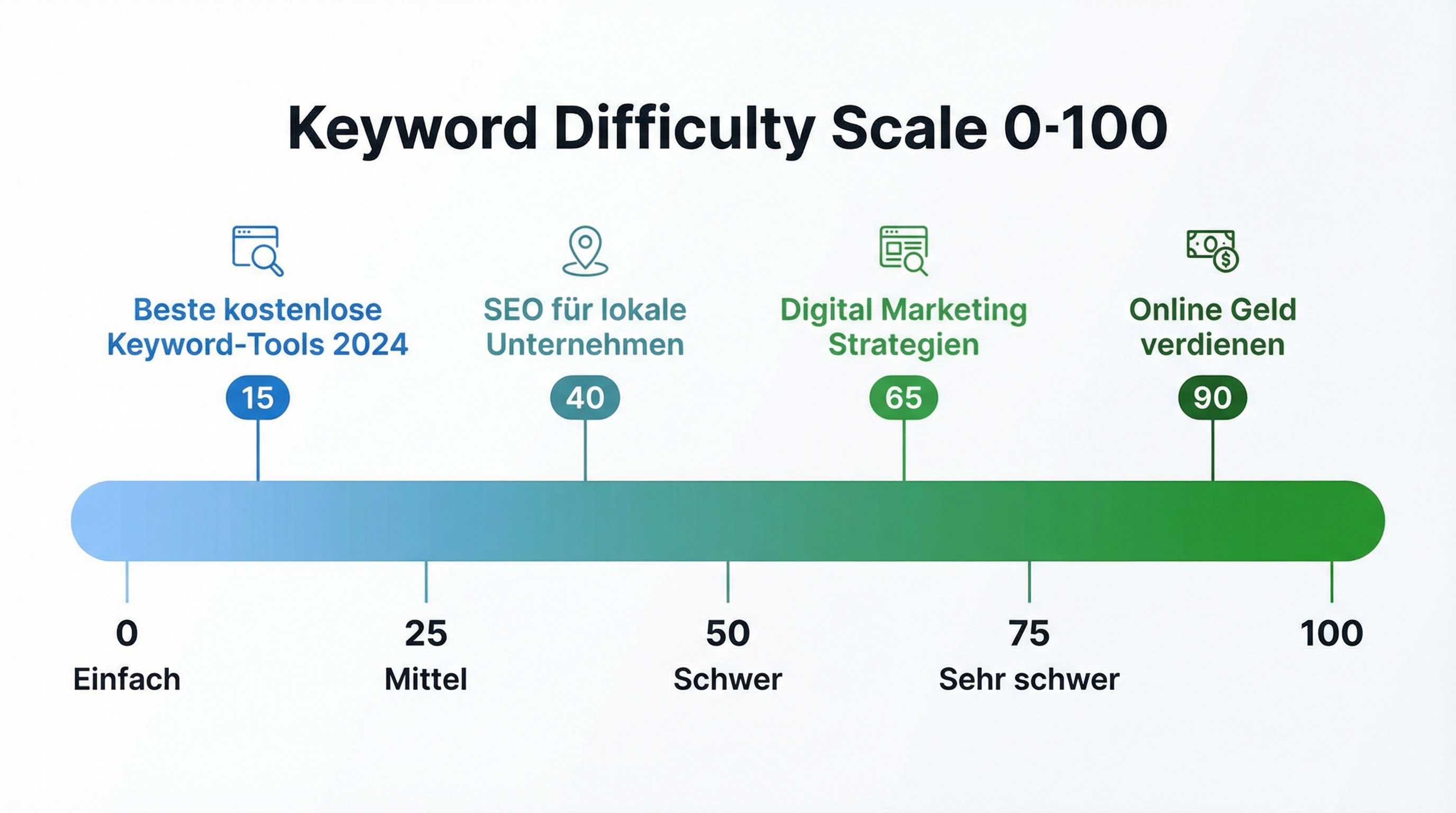
Keyword Difficulty, often abbreviated as KD, is a metric that measures how hard it is to rank for a specific keyword in search results. It is usually expressed on a scale from 0 to 100. A lower value means it is relatively easy to rank for that keyword, while a higher value indicates strong competition.
For new or less authoritative websites, it is commonly recommended to focus on keywords with a KD between 0 and 50. This approach helps you gain visibility faster without having to compete directly with well-established domains that dominate highly competitive keywords.
Importance of the SERP Difficulty Score
The SERP Difficulty Score, or SD, complements keyword difficulty by analyzing the actual competition on the first page of search results. Tools like LowFruits use an SD scale from 1 to 3, where 1 represents the easiest level.
This score takes factors such as the domain authority of ranking pages into account and highlights so-called “weak spots.” These are situations where lower-authority websites rank on page one. Identifying these gaps is extremely valuable because it signals opportunities where your site could realistically break into the top 10.
How do these metrics influence keyword selection?
Understanding keyword difficulty and SERP difficulty is crucial when choosing the right keywords. Think of it like planning a hike. You choose a trail based on your fitness level and the terrain. In the same way, you should choose keywords that match your website’s authority and resources, without facing overwhelming competition.
By prioritizing keywords with lower difficulty scores, you increase your chances of ranking higher and generating more organic traffic in a sustainable way.
Optimization strategies
To optimize your SEO strategy, you should regularly monitor both keyword difficulty and SERP difficulty scores. Tools such as Semrush and Ahrefs provide detailed insights into these metrics.
Filter for keywords that combine a low KD with a low SERP difficulty score. This combination often points to high-potential opportunities where well-structured, high-quality content can outperform existing results.
In summary, keyword difficulty and SERP difficulty score are indispensable metrics for any successful SEO strategy. They help you understand the competitive landscape and guide you in creating content that has a realistic chance of ranking well. Regular review and adjustment of your approach is essential for long-term SEO success.
Keyword Clustering and Content Strategy
Imagine running a bookstore. You have thousands of books, but without a clear structure, customers struggle to find what they are looking for. The same applies to keywords and your content strategy. This is where keyword clustering comes into play.
What is keyword clustering?
Keyword clustering means organizing related keywords into groups. Instead of looking at individual keywords in isolation, you group them by topic or search intent. It is similar to sorting books by genre. This approach allows you to create content that is comprehensive and thematically consistent.
Benefits of clustering for your content strategy
Keyword clustering offers several advantages:
Improved relevance: By grouping keywords, you can create content that covers multiple related search queries, making your pages more relevant for search engines.
Increased visibility: Creating thematically focused content improves your chances of ranking for multiple keywords. This is especially important given that 96.55 percent of all content receives no organic traffic from Google.
Efficient content production: A clear cluster plan helps you plan and produce content strategically, saving time and resources.
Better user experience: Users find the information they are looking for more easily, which increases time on site and reduces bounce rates.
Practical implementation and tips
How can you implement keyword clustering in practice? Here are some tips:
Keyword research: Use tools such as Semrush or Ahrefs to identify relevant keywords. Pay attention to keyword difficulty and SERP difficulty to find keywords with lower competition.
Topic-based groups: Organize keywords by topic or search intent. Create a comprehensive guide or a series of articles for each cluster.
Content planning: Build a content calendar based on your clusters. This helps structure your content strategy over the long term.
Continuous optimization: Review your keyword strategy regularly and adjust your clusters to new trends or changing search intent.
By strategically clustering keywords, you can take your content strategy to the next level. The goal is to understand user needs and provide content that addresses those needs comprehensively. This makes your website more attractive not only to search engines, but also to your visitors.
Common Mistakes in Keyword Gap Analysis
When conducting a keyword gap analysis, several pitfalls can significantly reduce the effectiveness of your SEO efforts. Let’s take a closer look at the most common mistakes and how to avoid them.
Choosing the wrong competitors
A frequent mistake is selecting the wrong competitors for the analysis. Many people focus on large, well-known brands that may not be their most direct competitors. Instead, you should choose companies that operate in your specific niche and target a similar audience. This allows you to identify keywords that are truly relevant to your users.
Solution: Research competitors that are successful in your niche. Use tools like Semrush or Ahrefs to identify websites that appear in search results for your main keywords.
Insufficient data filtering
Another common issue is poor data filtering, which can result in being overwhelmed by irrelevant keywords. Without proper filtering, it is easy to lose focus and miss valuable opportunities.
Solution: Apply filters to limit results to keywords with low keyword difficulty, typically KD 0 to 50, and meaningful search volume. Make sure the keywords are not only easy to rank for, but also have clear search intent.
Ignoring search intent
Neglecting search intent often leads to targeting keywords that generate traffic but fail to convert. Search intent reveals what users actually want and what type of content they expect to see.
Solution: Analyze the intent behind each keyword. Ask whether users are looking for information, a product, or a service, and align your content strategy accordingly.
Conclusion
Keyword gap analysis is a powerful tool, but only when applied correctly. By avoiding these common mistakes, you can ensure that your analysis leads to a stronger and more effective content strategy. It is not just about finding gaps, but about using them strategically to achieve your SEO goals.
FAQ: Keyword Gap Analysis
A keyword gap analysis often raises questions, especially if you are new to SEO. Here are answers to some of the most common ones.
How often should a keyword gap analysis be performed?
Ideally, you should conduct a keyword gap analysis every 6 to 12 months. Regular reviews help you stay up to date with competitor strategies and allow you to adapt your content strategy accordingly. Since markets and search behavior change constantly, this ensures you do not miss valuable opportunities.
Which tools are best for beginners?
For beginners, tools like Google Keyword Planner are a solid starting point because they are free and easy to use. If you are ready to invest in more advanced tools, Semrush and Ahrefs are excellent choices. They offer comprehensive keyword gap analysis features and provide deep insights into competitor rankings. LowFruits is also a good option, especially if you are focusing on low-competition keywords.
How do you integrate keyword gap analysis into an existing SEO strategy?
Integrating keyword gap analysis into your existing SEO strategy is essential for success. Start by prioritizing the identified keyword gaps and adding them to your content plan. Use these insights to create content that closes those gaps. Focus on keywords with lower keyword difficulty to achieve faster results. By regularly reviewing and adjusting your strategy based on your findings, you remain competitive over the long term.