
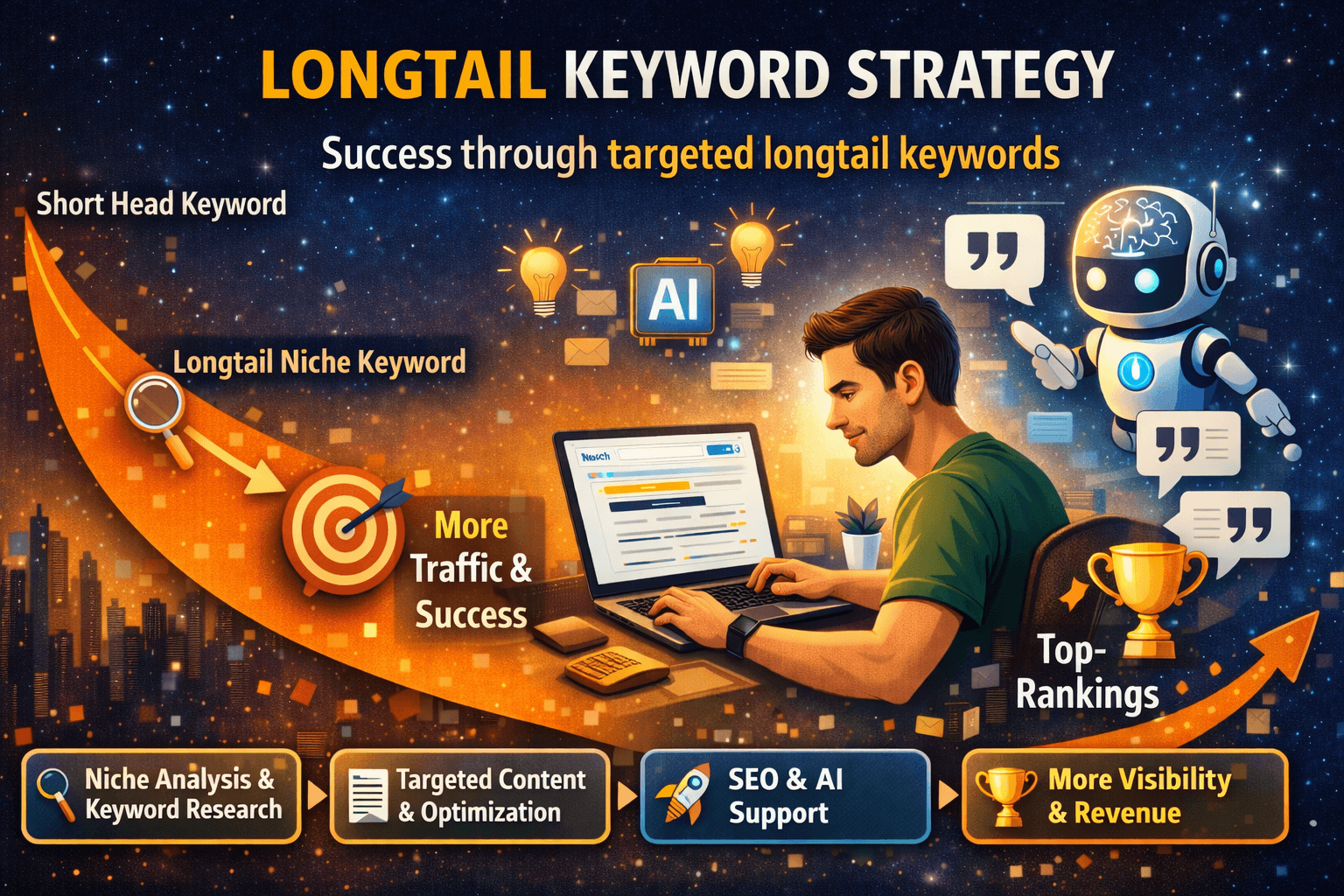
Long Tail Keywords: Definition, SEO Impact & How to Win in 2026
What Are Long Tail Keywords?
Let’s be honest: the phrase “long tail keywords” gets thrown around a lot, but most explanations leave you with more questions than answers. Maybe you’ve heard they’re just “really long search phrases.” Or that you need to stuff your content with five-word queries to win at SEO. But in practice, the real story is more nuanced—and way more useful—if you care about ranking and conversions in 2026.
What Really Makes a Keyword “Long Tail”?
The core of a long tail keyword isn’t just the number of words. It’s about specificity and user intent. Sure, many long tail keywords are longer (three words or more is common), but the real qualifier is how precise the search is—and how close the searcher is to taking action.
Picture this: someone types “shoes” into Google. You have no idea if they want to buy sneakers, learn shoe history, or fix a broken heel. That’s a head term—broad, high search volume, but vague intent. Now compare that to “best waterproof hiking boots for wide feet.” Suddenly, you know exactly what the user wants, and they’re probably ready to buy. That’s long tail.
Key traits of long tail keywords:
Specific, often multi-word search queries
Reflect a clear, actionable intent (buying, booking, solving a problem)
Lower individual search volume, but higher conversion rate
Easier to rank for, especially for new or niche sites
Anatomy of a Long Tail Keyword: Examples Across Industries
Let’s break down what this looks like in real scenarios:
Keyword Type | Example | User Intent | Conversion Potential |
Head (Short Tail) | shoes | Browsing, undefined | Low |
Body (Medium Tail) | men’s running shoes | Researching, some focus | Medium |
Long Tail | best waterproof hiking boots for wide feet | Ready to buy, highly specific | High |
Long Tail (Local) | electrician near me for faulty outlet repair | Service booking, urgent | High |
Long Tail (B2B/SaaS) | CRM software for real estate teams with mobile app | Solution seeking, decision phase | High |
Why does this matter? Because over 91% of all web searches are long tail keywords (yotpo.com). And they convert at a higher rate than their broad, high-volume cousins.
Common Misconceptions (and Why They Matter)
Let’s tackle a few myths that trip up even experienced marketers:
Myth 1: Long tail = long phrase. Not always. “Best CRM for freelancers” (four words) is long tail, but so is “buy iPhone 15 Pro Max” (five words), while “cheap flights” (two words) can be long tail if the intent is clear and specific enough.
Myth 2: Long tail keywords aren’t worth the effort because of low search volume. In reality, these queries collectively dominate the search landscape. If you add up all the unique, intent-rich searches, you get the majority of real-world traffic—and the best conversion rates.
Myth 3: You need to target hundreds of random long phrases to win. In practice, it’s about understanding your audience’s needs and matching your content to their specific questions. Tools help, but real insight often comes from user-generated content and reviews (see our discussion of keyword gap analysis for more).
Why This Distinction Matters in 2026
With Google’s AI Overviews now answering broad queries directly, the old “rank for the biggest term” playbook is less effective. Long tail keywords let you reach people further along in the buying journey—people who want your solution, not just information. This is even more relevant for local SEO, PPC, and e-commerce, where matching search intent is everything.
If you’re building your content strategy, focus on real search intent and specificity, not just word count. That’s how you connect with the right audience—and actually get results.
Still unsure how to spot real long tail keywords for your business? In the next section, we’ll show how to find and validate them using practical tools and real customer data.
Why Long Tail Keywords Matter in SEO (2026 Update)
Let’s be honest: if you’ve tried to rank for big, broad keywords lately, you’ve probably felt the wall. You pour hours into “coffee” or “CRM software” only to see Google’s AI Overviews answer the query right in the search results—no click, no traffic, just a dead end. That frustration isn’t just you. It’s the new normal in 2026.
But here’s the upside: the search game hasn’t died, it’s just moved. The real opportunity now? Long tail keywords. These are the ultra-specific, intent-driven search phrases—think “best waterproof hiking boots for wide feet” or “how to automate invoices in Xero for freelancers.” They’re not glamorous. They don’t bring in 10,000 clicks a month. But they’re where real business happens.
The Shift: From Head Terms to the Long Tail
Short-tail (or “head”) keywords used to be the holy grail. Huge search volume, lots of eyeballs. But in 2026, Google’s AI Overviews and similar AI engines answer these broad queries directly. If someone types “best CRM,” Google summarizes the top options, and most users never leave the page. Your organic result? Buried, if it even shows up.
Long tail keywords flip that script. AI engines struggle to answer highly specific, niche questions in a way that satisfies everyone. That leaves the door open for your content to rank—and actually get clicked.
Short-tail keyword: “sofa” (vague, low conversion, high competition, likely answered by AI Overview)
Long-tail keyword: “mid-century modern grey sectional sofa for small apartment” (high intent, low competition, rarely answered by AI, strong conversion)
Why Long Tail Keywords Dominate in 2026
Collective Power: Individually, long tail keywords have low search volume. But together, they account for over 91% of all web searches. That’s the bulk of real-world search traffic.
High Conversion Rates: People using long tail queries are usually further along in the buying cycle. They know what they want. That’s why these searches convert at a much higher rate than broad keywords.
Easier to Rank: Because these phrases are so specific, there’s less keyword competition. Even newer or smaller sites can break through—no need for a massive domain authority.
Voice Search and AI: With voice assistants and AI chatbots, users ask questions in natural, conversational language. That feeds directly into long tail territory. “Siri, where can I buy vegan gluten-free birthday cakes near me?” isn’t a head term—it’s a long tail goldmine.
Trade-Offs and Common Missteps
Let’s get real about the trade-offs. Long tail keywords won’t bring you viral traffic overnight. Each phrase might get just a handful of searches a month. But those users are ready to act—buy, book, sign up. That’s why the conversion rate is so much higher.
Common mistake? Chasing only search volume. In practice, focusing on high-volume terms today means fighting AI and enterprise brands for scraps. Instead, stacking dozens (or hundreds) of long tail pages, each targeting a specific need, is what drives sustainable growth.
Practical Takeaway
If you’re still building your SEO strategy around head keywords, you’re fighting yesterday’s battle. In 2026, the brands that win are those who embrace the long tail—using real customer language, mining user-generated content, and mapping out every niche question or need. For more on how to spot and validate the right long tail phrases, check out our deep dive into keyword research tools and customer data strategies.
And if you want to see how AI is changing the rules even further, our guide to ChatGPT SEO in 2026 breaks down the latest tactics.
Ready to move from “window shoppers” to real customers? Focus your SEO on the long tail—where intent, not just impressions, drives results.
Long Tail vs. Short Tail Keywords: Key Differences & When to Use Each
Why the Long Tail Wins: Comparing Keyword Types, Intent, and When Each Makes Sense
Ever tried ranking for “shoes”? It’s like shouting at a stadium full of people, hoping the one person looking for “vegan waterproof trail shoes size 42” hears you. That’s the emotional gap between short-tail and long-tail keywords: one’s a crowd, the other’s a conversation. Let’s break down what actually separates these keyword types, where each shines, and where most sites trip up.
The Three Zones: Head, Body, and Long Tail
SEO pros often talk about the “head,” “body,” and “long tail” of search. Here’s what that means in practice:
Keyword Type | Example | Search Intent | Search Volume | Conversion Potential | Competition |
Head (Short-Tail) | shoes | Vague (browse/define) | Very High | Low | Extreme |
Body (Medium-Tail) | men’s running shoes | Some focus (research) | High | Medium | High |
Long Tail | best waterproof hiking boots for wide feet | Specific (ready to buy) | Low (each) | High | Low |
Short-tail keywords (“shoes,” “coffee”) are broad, high-volume, and brutally competitive. They attract everyone: buyers, browsers, researchers, bots. Conversion rates? Usually disappointing.
Body keywords (“men’s running shoes”) narrow things a bit, but you’re still battling big brands.
Long-tail keywords (“best waterproof hiking boots for wide feet”) are laser-focused. The searcher knows what they want. These drive over 91% of all web searches and convert at a higher rate (source: yotpo.com/blog/long-tail-keywords-guide/).
When to Prioritize Each Keyword Type
Let’s get practical. Here’s how to decide which keyword “zone” fits your situation:
If your site is new, has low domain authority, or a limited SEO budget, then focus on long-tail keywords. You’ll rank faster, face less competition, and reach users who are ready to act. This is especially true for local businesses, SaaS startups, and niche e-commerce.
If you’re an established brand with strong authority and a big content team, then you can mix in body and even some head terms—but only if you’re ready for a long, expensive battle.
If your main goal is brand awareness (not conversions), short-tail can make sense—but don’t expect immediate sales.
If you want to drive qualified leads or sales with minimal waste, then long-tail is almost always the best starting point.
Real-World Scenarios: E-Commerce, Local, SaaS
E-commerce: “laptops” vs. “best lightweight laptops for video editing under $1000 2026.” The second phrase attracts someone ready to buy, not just browse.
Local SEO: “coffee shop” vs. “organic coffee shop open late near Berlin Hauptbahnhof.” The long-tail version is what voice searchers (and Google Maps users) actually say.
SaaS: “CRM software” vs. “affordable CRM for small nonprofits with event tracking.” The latter brings in users with a clear need and higher conversion potential.
Common Mistakes: Where Most Get It Wrong
Chasing search volume: Many still obsess over big numbers. But high search volume means nothing if the intent is wrong. Ranking for “shoes” might bring traffic, but not buyers.
Ignoring search intent: If you don’t map keywords to the user journey, you’ll get the wrong visitors. Someone searching “how to fix cracked leather shoes” probably isn’t ready to buy new ones—yet.
Underestimating competition: Trying to outrank Amazon or Wikipedia for broad terms is a losing game for 99% of sites.
Not using real user language: The best long-tail keywords often come from user-generated content and reviews, not keyword tools alone.
Why New and Small Sites Should Start with Long-Tail—Almost Always
Here’s the blunt truth: unless you already have massive authority, short-tail keywords are a money pit. Long-tail keywords let you:
Get on page one faster, even with a small site.
Attract visitors who are closer to buying or taking action.
Avoid wasting resources fighting giants.
Build topical authority in a niche, which over time makes ranking for broader terms easier.
If you’re not sure where to start, focus on long-tail. Use your own customer questions, reviews, and feedback as a goldmine for real search queries. For more on how to find these, our section on how to find long-tail keywords breaks it down step by step.
Bottom line: In 2026, long-tail keywords aren’t just a “nice to have”—they’re the foundation of sustainable SEO, especially for those who can’t outspend or out-muscle the competition. If you want to move from “window shoppers” to real customers, this is where you start.
How to Find Effective Long Tail Keywords (Step-by-Step, 2026 Tools)
Let’s be honest: most people hit a wall with keyword research not because long-tail keywords are rare, but because finding the right ones—and knowing they’ll actually work—is messy. The tools are everywhere, but the signal-to-noise ratio is brutal. So, how do we cut through the noise? Here’s a practitioner’s guide, grounded in what actually works in 2026.
Why Discovery (Not Existence) Is the Real Challenge
Long-tail keywords make up over 91% of all search queries, but they’re scattered and unpredictable. The real bottleneck is surfacing those with genuine search intent and conversion potential. Too many marketers still chase what their tool spits out, ignoring what real users are actually asking.
Step 1: Start With Real-World Language (Brainstorm & UGC)
Before you even open a tool, listen to your customers. User-generated content (UGC)—reviews, Q&A sections, support tickets—is a goldmine for uncovering natural, high-intent phrases. For example, a review saying “I need a laptop that runs quiet for video calls at night” is a ready-made long-tail keyword. In practice, exporting review data or scraping your support inbox can reveal dozens of unique, conversion-ready queries.
Step 2: Analyze the SERP and “People Also Ask”
Next, plug those phrases into Google and study the search results. What’s ranking? If the top results are product pages, the intent is transactional. If it’s blog posts or guides, it’s informational. The “People Also Ask” box often surfaces related long-tail questions you’d never brainstorm on your own—these are gold for content ideas.
Step 3: Competitor & Gap Research
Check what your competitors are ranking for using tools like Ahrefs, SEMrush, or ClickRank AI. Look for keywords where they have content but you don’t—classic keyword gap analysis.
Step 4: Use Free and Paid Keyword Research Tools
Free tools (when to use):
Google Search Console: See what actual queries bring users to your site—often full of long-tail gems.
AnswerThePublic: Visualizes question-based searches around your seed topic.
Reddit/Forums: Real user questions, especially in niche communities.
Google’s People Also Ask: For expanding on initial ideas.
Paid tools (when to invest):
Targos/SEMrush: For volume, competition, and SERP analysis at scale.
ClickRank AI: Especially strong for voice search and AI-driven query prediction.
Rankability: Useful for tracking and clustering long-tail opportunities.
Decision logic: If you’re just starting or have a tight budget, free tools are enough to get moving. For ongoing, competitive SEO or e-commerce, paid tools save time and reveal deeper opportunities.
Step 5: Validate Search Intent and Volume—Don’t Blindly Trust Scores
Many fall into the trap of trusting keyword difficulty or volume scores at face value. In reality, these are estimates—sometimes wildly off for long-tail queries. Always check the live SERP: does the content match your planned page? Are there ads (PPC competition)? Is the query commercial or just curiosity? If in doubt, test with a small PPC campaign or add the keyword to a FAQ and monitor engagement.
Common Pitfalls (and How to Avoid Them)
Over-reliance on tools: Tools miss nuance—real user language is often more valuable.
Ignoring SERP intent: Ranking for a keyword is pointless if the searcher wants something else.
Chasing “easy” scores: Low-competition doesn’t mean high-conversion; always check intent and context.
Mini-Case: Niche E-Commerce Walkthrough
Imagine you sell eco-friendly pet toys. You start by pulling phrases from your reviews (“durable chew toy for aggressive chewers,” “non-toxic dog toy for teething puppies”). Next, you check Google’s “People Also Ask” for related questions. You notice competitors rank for “best sustainable dog toys 2026,” but nobody addresses “plastic-free dog toy for small breeds.” You validate the SERP—mostly product pages, so intent is right. Using Ahrefs, you see low competition. You create a targeted product page and a supporting FAQ. Within weeks, you see qualified traffic and a bump in conversion rate.
Takeaway: Synthesis Over Automation
Real progress comes from blending tool-driven data with human insight. Start with UGC, validate with SERP analysis, and only then use tools to scale.
Action step: Pick one product or service, mine your reviews and support logs for natural phrases, and run them through the steps above. Don’t chase volume—chase intent.
Optimizing Content for Long Tail Search Intent (Practical Tactics & Structure)
Practical Approaches to Structuring Content for Long-Tail Search Intent
Let’s be honest: most of us have run into the frustration of spending hours on a blog post, only to see it buried by AI Overviews or big brands targeting broad keywords. The reality in 2026? If you want your content to be found—by humans and AI alike—you need to structure for long-tail search intent. Here’s how we approach this in practice, with a focus on what works, what doesn’t, and why.
Topic clusters built around long-tail keywords boost authority and relevance.
Use long-tail phrases naturally in headings, FAQs, and throughout the page.
Write for both Google and AI engines (like ChatGPT, voice assistants).
Avoid keyword stuffing; depth and variety matter more than repetition.
Don’t tunnel-vision on one phrase—cover related queries to match real search journeys.
Why Topic Clusters Win for Long-Tail SEO
If you’re only targeting one long-tail keyword per page, you’re leaving relevance (and traffic) on the table. The topic cluster model groups related long-tail queries under a broader theme, signaling to search engines that you’re a true authority—not just a one-hit wonder. For example:
Pillar page: “Best waterproof hiking boots”
Cluster pages: “Best waterproof hiking boots for wide feet,” “Best waterproof hiking boots for winter,” “Best waterproof hiking boots under $100”
This structure lets you rank for dozens of specific queries, not just one. It also helps users find exactly what they need, which improves user experience and reduces bounce rate (see clickrank.ai). In practice, we map out clusters before writing, using keyword research tools and user-generated content (like reviews and FAQs).
Where to Place Long-Tail Keywords (and Where Not To)
Headings and Subheadings: Use long-tail keywords in H2s and H3s where it feels natural. For example, instead of “Features,” use “Features of waterproof hiking boots for wide feet.” This helps both search engines and users understand the page’s focus.
FAQ Sections: Long-tail queries are often phrased as questions. Adding a FAQ block with real user questions (mined from reviews or tools like AnswerThePublic) catches voice search and AI queries you’d otherwise miss. Example:
“What are the best waterproof hiking boots for flat feet?”
“Are waterproof hiking boots good for winter?”
On-Page Copy: Blend long-tail phrases into the body text, but don’t force them. If you catch yourself repeating the same phrase every other paragraph, you’re probably over-optimizing. Google (and users) pick up on this fast.
Writing for Google, ChatGPT, and Voice Search
Search is everywhere now: Google, ChatGPT, Alexa, even in-car assistants. That means your content needs to be clear, conversational, and structured.
Use natural language—write how people ask questions, not how SEO tools spit out phrases.
Short, direct answers up top (“answer-first”) help with featured snippets and AI summaries.
Structure matters: bullet points, tables, and clear headings make it easy for AI to parse your content.
Avoiding the Classic Mistakes
Don’t:
Stuff the same long-tail keyword everywhere (“best waterproof hiking boots for wide feet” in every heading and paragraph).
Ignore related queries—users rarely search in a straight line.
Write for bots only; if it sounds robotic, you’ll lose both rankings and trust.
Do:
Cover variations and related questions (think: “best waterproof hiking boots for women,” “are waterproof hiking boots breathable?”).
Use semantic keywords and synonyms naturally.
Focus on solving the user’s actual problem, not just matching a phrase.
Real-World Example:
Say you’re building a guide on “affordable SEO services for small businesses.” Instead of one page, create a pillar page for the main topic, then cluster pages for “affordable SEO services for local businesses,” “affordable SEO packages for e-commerce,” and so on. Each page answers specific questions and links back to the main pillar, building authority and covering the full spectrum of search intent.
Final Takeaway
Optimizing for long-tail search intent isn’t about gaming the system—it’s about building content that genuinely answers real, specific user needs. If you structure your content around topic clusters, use long-tail phrases where they help, and write for both humans and AI, you’ll see stronger rankings and happier users.
Action Step: Before writing your next piece, map out a topic cluster with at least 3-5 related long-tail phrases. Structure your headings and FAQs around real user questions. Focus on depth, not just repetition. That’s how you win long-tail SEO in 2026.
Long Tail Keywords in Action: PPC, E-commerce, and Local SEO
Turning Search Intent into Results: How Long-Tail Keywords Power PPC, E-commerce, and Local SEO
Let’s get real for a second. Most of us have thrown money at broad keywords in Google Ads or tried to rank a generic product page, only to see disappointing results. If you’ve ever wondered why your ad spend doesn’t translate into sales, or why your local service page gets traffic but no calls, you’re not alone. Here’s what’s usually missing: a focus on search intent, delivered through long-tail keywords.
Why Long-Tail Keywords Win in PPC Campaigns
If you’re running pay-per-click (PPC) ads, you know the pain of high costs and low conversion rates on broad terms. Here’s the fix: long-tail keywords. These phrases are specific—think “emergency plumber open Sunday Berlin” instead of just “plumber.” According to link-assistant.com, long-tail keywords connect you with people who are closer to making a decision, like buying or booking. That means:
Lower cost-per-click: Less competition drives prices down.
Higher conversion rates: Users are further along in the buying cycle.
Better ad relevance: You match exactly what the searcher wants.
But there’s a catch. If you ignore negative keywords (terms you don’t want your ad to show for), you’ll still waste budget on irrelevant clicks. Always build a negative keyword list alongside your long-tail targeting.
E-commerce: Product Pages That Actually Sell
Here’s where long-tail keywords shine. Imagine a shopper searching for “vegan leather ankle boots size 42 waterproof.” If your product page is optimized for that exact phrase, you’re not just another store—you’re the answer to their problem. This specificity increases your chances of ranking and, more importantly, converting.
Product titles and descriptions: Use real phrases from customer reviews (user-generated content) to capture natural language.
Image alt text: Don’t just write “boots”—describe them as “vegan leather waterproof ankle boots size 42.”
FAQ sections: Address long-tail search queries directly, like “Are these boots suitable for wide feet?”
Local SEO: Service Queries That Drive Real Leads
Local businesses live or die by intent. Someone searching “best pediatric dentist near me open Saturday” is ready to book. Optimizing your Google Business Profile and landing pages for these specific queries means you’re visible when it matters.
Service pages: Use long-tail phrases in headings and meta descriptions.
Reviews and testimonials: Encourage customers to mention specifics (“fixed my leaking kitchen tap on a Sunday”).
Location signals: Combine service + location + qualifier (“24/7 locksmith Kreuzberg emergency”).
Matching Ad Copy and Landing Pages: Practical Table
Long-Tail Keyword | Ad Copy Example | Landing Page Focus |
“emergency plumber open Sunday Berlin” | “Need a plumber in Berlin today? Open Sundays!” | Fast booking, Sunday availability, map |
“vegan leather ankle boots size 42 waterproof” | “Shop size 42 vegan boots—waterproof & stylish” | Product specs, sizing guide, reviews |
“best pediatric dentist near me open Saturday” | “Saturday appointments for kids—Book now!” | Booking form, insurance info, directions |
Pitfalls to Avoid
Neglecting negative keywords: You’ll bleed budget on irrelevant clicks.
Mismatch between keyword and landing page: If your page doesn’t answer the query, users bounce (and Google notices).
Overlooking user-generated content: Real customer language is your best source for long-tail phrases.
Action Step
Audit your next campaign or product page. Are you targeting broad, vague terms, or are you matching real user intent with long-tail keywords? If not, start by reviewing your own reviews and support tickets for the phrases people actually use.
Common Mistakes and Limitations When Targeting Long Tail Keywords
Where Long-Tail Keyword Targeting Goes Wrong: Real-World Pitfalls
Let’s be honest—long-tail keywords are powerful, but they’re not a magic bullet. If you’ve ever spent hours researching phrases like “best eco-friendly dog shampoo for puppies with allergies” and wondered why your traffic or conversions didn’t spike, you’re not alone. Plenty of sites fall into the same traps. Here’s a closer look at the most common mistakes, why they happen, and what to do instead.
Mistake 1: Sacrificing Content Quality for Keyword Fit
It’s tempting to create thin, repetitive content just to “hit” lots of long-tail keywords. But in practice, Google’s AI is ruthless about low-value pages. If your article is just a clumsy rehash of a search phrase (“Best hiking boots for wide feet in 2026” with no real advice), you’ll struggle to rank—no matter how niche the keyword. Quality, depth, and actual usefulness always trump rigid keyword stuffing. If you’re not sure, ask: Would a real person bookmark or share this page?
Mistake 2: Chasing Ultra-Niche, No-Demand Phrases
Not every long-tail keyword is worth pursuing. Some are so specific (“best vegan gluten-free carrot cake recipe with coconut flour and no nuts”) that they get zero meaningful search volume. If your keyword research tool shows no demand, or if your own analytics confirm nobody’s searching, skip it. In these cases, your time is better spent on broader queries or related topics with proven interest.
Mistake 3: Over-Reliance on Automated Keyword Tools
Most keyword research tools (even the best ones) can spit out endless lists of “long-tail” suggestions. The problem? Many are irrelevant, awkward, or don’t reflect how real people search. Blindly publishing pages for every suggestion can clutter your site, dilute your topical authority, and confuse both users and search engines. Always sanity-check tool output against real user language—reviews, support tickets, or even competitor FAQs.
Trade-Offs: Lower Per-Page Traffic, Risk of Cannibalization
By nature, long-tail keywords mean lower search volume per page. That’s fine if your goal is high conversion rate, but it also means you’ll need more content to achieve significant traffic. Plus, if you target too many similar phrases (“best running shoes for flat feet” vs. “top sneakers for flat-footed runners”), you risk cannibalizing your own rankings—where multiple pages compete for the same intent and neither performs well.
When to Scale Up Beyond Long-Tail
If your site already dominates a niche and you see diminishing returns from ultra-specific queries, it’s time to expand to broader, higher-volume terms.
If you’re not seeing enough conversions or traffic from your long-tail content, revisit your keyword gap analysis to identify better opportunities.
If your audience or product is very mainstream (e.g., “coffee”), you’ll need a hybrid approach: use long-tail for conversion pages, but also invest in topic clusters and broader guides to build authority.
Bottom Line
Long-tail keyword targeting works—when it’s intentional, data-driven, and paired with genuinely helpful content. Don’t let tools or “best practice” checklists distract you from real user needs. And if you’re stuck, check out our deep dive into Marketing Intelligence in 2026 for smarter, intent-driven strategies.
FAQs About Long Tail Keywords (2026 Edition)
Let’s get right into the real questions that come up when you’re knee-deep in keyword research. If you’ve ever wondered whether you’re focusing on the right search queries, or if chasing those “zero volume” long-tail keywords is worth it, you’re not alone. Here’s what we’re hearing most often in 2026—and what actually matters in practice.
What defines a long-tail keyword in 2026?
The textbook answer is: a long-tail keyword is a specific, multi-word search phrase that signals clear intent—think “best waterproof hiking boots for wide feet” instead of just “hiking boots.” But in 2026, it’s less about the word count (three or more is typical) and more about how closely the phrase matches a user’s real problem or need. If someone is searching with a question or a detailed description, you’re in long-tail territory. This is especially true with voice search and AI engines, which thrive on conversational, specific queries.
Why are long-tail keywords more important now than five years ago?
Short version: Google’s AI Overviews and similar features now answer broad, generic questions right in the search results—often without sending traffic to your site. That means “head” keywords like “insurance” or “coffee” are even less useful for most brands. Long-tail keywords, on the other hand, capture users who are further along in their decision process and have a higher conversion rate. They’re also less likely to be fully answered by AI summaries, so your content still gets the click.
How do I balance long-tail and short-tail targeting?
If you’re a new or smaller site, focus most of your effort on long-tail keywords. The competition is lower, and you can rank faster—even with low domain authority. For established brands, it’s about building a topic cluster model: use short-tail keywords as “hubs” and long-tail phrases as “spokes” that address specific user needs. This approach boosts topical authority and helps you own a niche, as outlined in our guide to Keyword Gap Analysis.
Is there a minimum search volume to consider?
Here’s the honest answer: there’s no hard minimum. Many long-tail keywords show “zero” or very low search volume in tools, but still drive valuable traffic—especially when you aggregate dozens or hundreds of them. What matters is intent and relevance. If a phrase matches what your customers actually ask (e.g., in reviews or support tickets), it’s worth targeting, even if the tools say otherwise.
What if my long-tail keywords get zero traffic?
Don’t panic. Keyword tools are notoriously bad at detecting ultra-specific or emerging queries. If you’re pulling phrases from user-generated content, support logs, or real conversations, you’re likely ahead of the curve. Over time, these pages can build up “long-tail” traffic that compounds. If after 6-12 months you see no impressions or clicks in Google Search Console, then it might be time to adjust—or check if your content actually answers the query.
How do I measure success with long-tail SEO?
Look beyond single-keyword rankings. Instead, track:
Total impressions and clicks for all your long-tail pages (via Google Search Console)
Conversion rate from long-tail landing pages (often higher than site average)
Engagement metrics: time on page, bounce rate, scroll depth
If you see steady growth in these areas, your long-tail strategy is working—even if no single keyword is a “winner.” For more on measuring and refining your approach, see our deep dive into Marketing Intelligence in 2026.
Still have questions? It’s normal. Long-tail SEO is less about chasing big numbers and more about matching real user intent. If you’re unsure where to start, listen to your customers first—their language is your best keyword research tool.